
National Symbols
The flags, colours, and symbols that represent the Kaharagian nation.
National Symbols of Kaharagia
Since the foundation of the Principality on 16 July 2010, its national symbols have served as visible marks of Kaharagian identity.
Our symbols draw from two heraldic traditions: the Royal Family and the Order of Saint Michael. Together, they reflect the twin pillars of Kaharagian national life: the Sovereign who guards and unites the nation, and the chivalric ideals of honour, duty, and service.
The Flags
The flags of Kaharagia are public signs of national identity, carried in ceremony, displayed on state occasions, and flown to mark the presence of the Sovereign or the activity of the State. Their legal descriptions, precedence, and use are established by Article 19 of the Fundamental Laws.
The Royal Standard
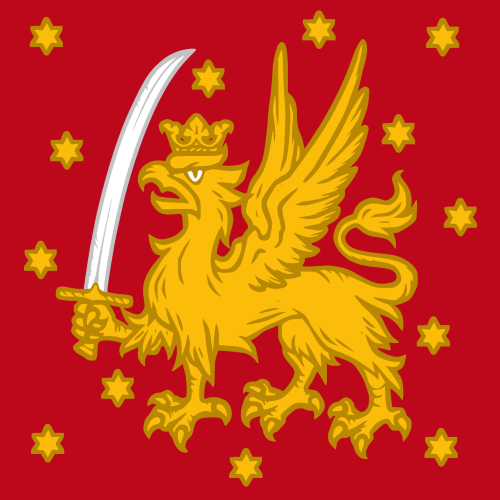
Standard of the Sovereign
The Standard is a square banner bearing the Arms of Kaharagia: a gold crowned griffin holding a scimitar on a red field strewn with gold six-pointed stars. It is the personal standard of the Sovereign and takes precedence over every other flag of Kaharagia.
The Standard is flown only when the Sovereign is in residence or present at an official occasion, or as otherwise authorised by the Sovereign. It is never flown at half-mast.
Official Flags
Alongside the Standard of the Sovereign, Article 19 establishes the Civil and National Flag, the State Flag, and Saint Michael's Flag. The first two are prescribed in the ratio of 4:3; no ratio is fixed for Saint Michael's Flag.
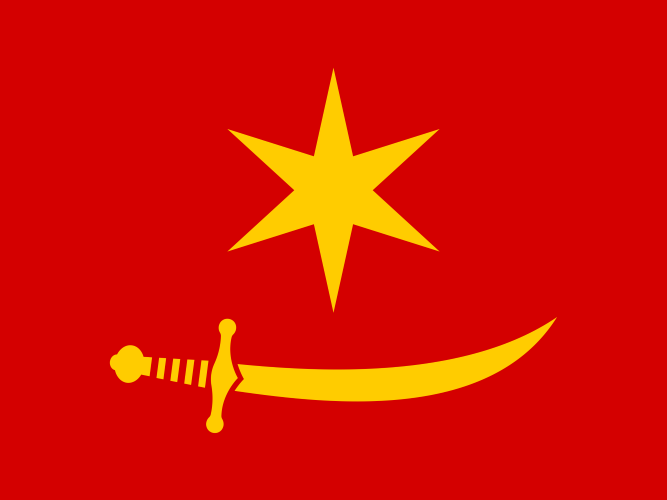
Civil and National Flag
Primary flag · Public useA red field bearing a gold six-pointed star above a gold scimitar. It represents the Kaharagian State and Nation together and may be used by any person.
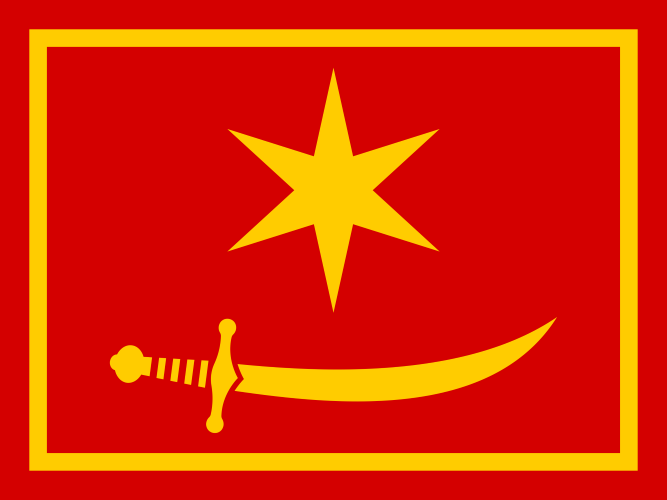
State Flag
Government useThe Civil and National Flag distinguished by a gold orle. It is reserved to the government, State agencies, and duly authorised officials.
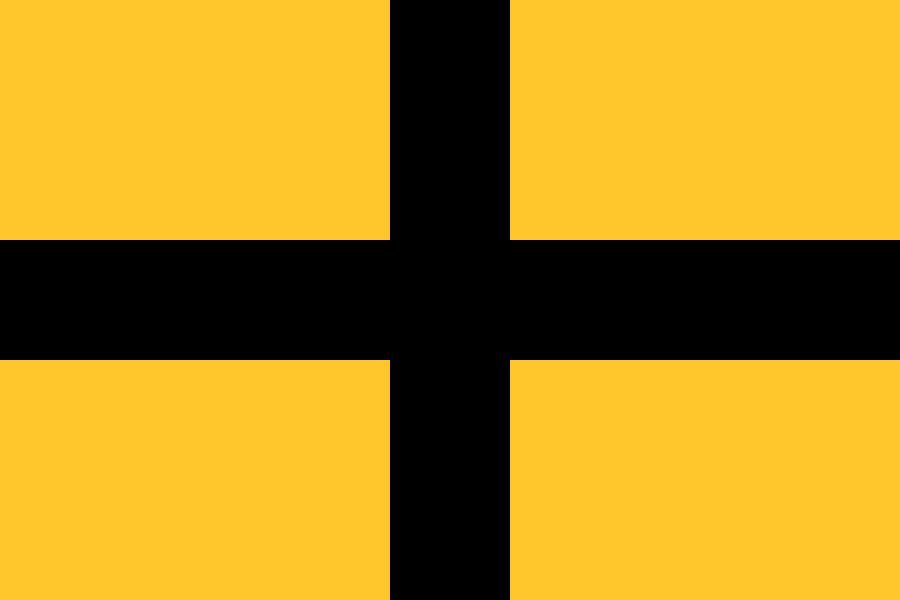
Saint Michael's Flag
Official flagA gold field bearing a centred black cross: the flag of Kaharagia's supreme order and its patron saint, Michael the Archangel.
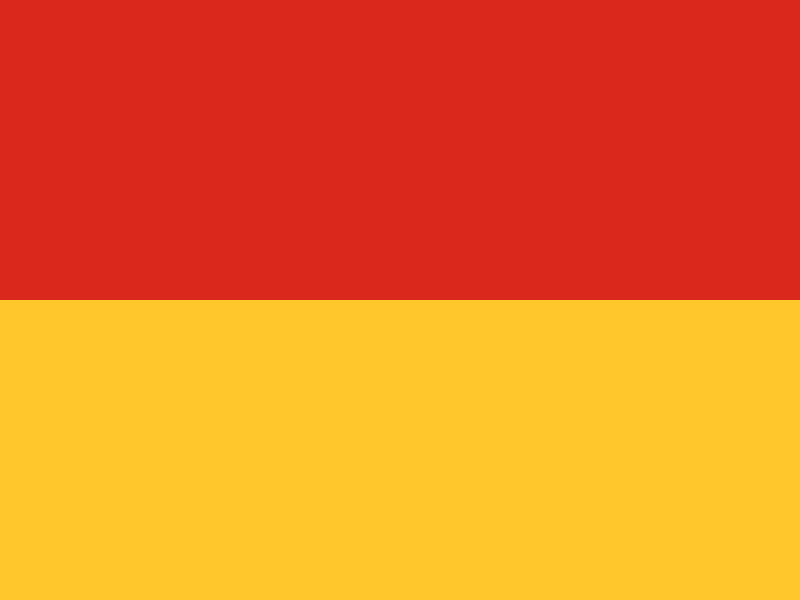
Royal Family Flag
Dynastic flag · 4:3Red over gold, drawn from the colours of the Royal Family Arms. It represents the Royal Family in dynastic and cultural contexts.
The Civil and National Flag takes precedence over every Kaharagian flag except the Standard of the Sovereign. Its scimitar signifies the people's readiness to defend the Nation, while its six-pointed star represents Sovereignty, Dignity, Peace, Charity, Honour, and Stewardship. When Saint Michael's Flag is flown with the Civil and National Flag or the State Flag, Article 19 recommends the same 4:3 ratio. The Royal Family Flag is shown here as a dynastic symbol and is not one of the State flags established by Article 19.
National Colours
The official colours of Kaharagia are drawn from the heraldry of the Royal Family and the Order of Saint Michael. They appear throughout official communications, government services, and national ceremonies.
Kaharagian Red is drawn from the Royal Arms. On the Civil and National Flag, it represents the determination, bravery, and blood of the Kaharagian people.
Kaharagian Gold is shared by the Royal Family and the Order of Saint Michael. On the Civil and National Flag, it represents the Kaharagians as the “Noble People”, reflecting the meaning of the word Kaharagian in the Kaharagian language.
Kaharagian Black comes from the Order of Saint Michael and speaks of solemnity and steadfastness. It forms the cross on the gold field of Saint Michael's Flag.
Coat of Arms
The coat of arms appears on official documents, government publications, treaties, and in ceremonial contexts. The Principality uses two versions of its arms, each suited to different purposes.
Royal Arms
The full achievement with supporters and mantle. Used in royal and ceremonial contexts.
State Arms
The shield and crown only, without external elements. Used by government and state institutions.
The Royal Arms, with supporters, mantle, and other external ornaments, are reserved for the Sovereign and the most formal royal occasions. The State Arms display only the shield surmounted by the princely crown. They serve the everyday work of government, appearing on official correspondence, identity documents, and the masthead of the Royal Kaharagian Gazette.
"Pro Deo Et Patria"
For God and Fatherland, Motto of the Royal Family
The greater achievement of the Royal Arms bears the motto of the Royal Family, Pro Deo Et Patria ("For God and Fatherland"), inscribed upon the scroll beneath the shield. This motto is distinct from the national motto and belongs exclusively to the Royal House, reflecting the personal dedication of the Sovereign and the Royal Family to faith and country.
The use of arms is regulated by the Institute of Heraldry, which oversees all matters of armorial bearings within the Principality.
National Motto
"For God, Prince, and Fatherland"
The national motto expresses the three pillars of Kaharagian national life.
For God: Many Kaharagians are people of faith, and the nation affirms the inherent dignity of every person as a foundation of law and conduct.
For Prince: At the centre of national life stands the Sovereign. Loyalty to the Prince is part of our common bond, a shared commitment to the continuity and unity of the nation.
For Fatherland: Kaharagia is defined not by borders but by belonging. Love of the Fatherland is love of this community and the ideals it upholds.